
How accurate is AI photo calorie counting?
Accurate enough to be useful, not accurate enough to be a laboratory measurement — and for changing your weight, that distinction matters less than most people assume.
Updated 29 July 2026 5 min read
The short answer
Photo-based estimates are generally good on recognizable, plated meals and weaker on mixed dishes, hidden fats, and portion size. But every method of tracking calories is an estimate, including weighing food and reading labels. What determines whether tracking works is not the precision of any single meal — it is whether you log consistently enough for the trend to be meaningful.
What the AI is actually doing
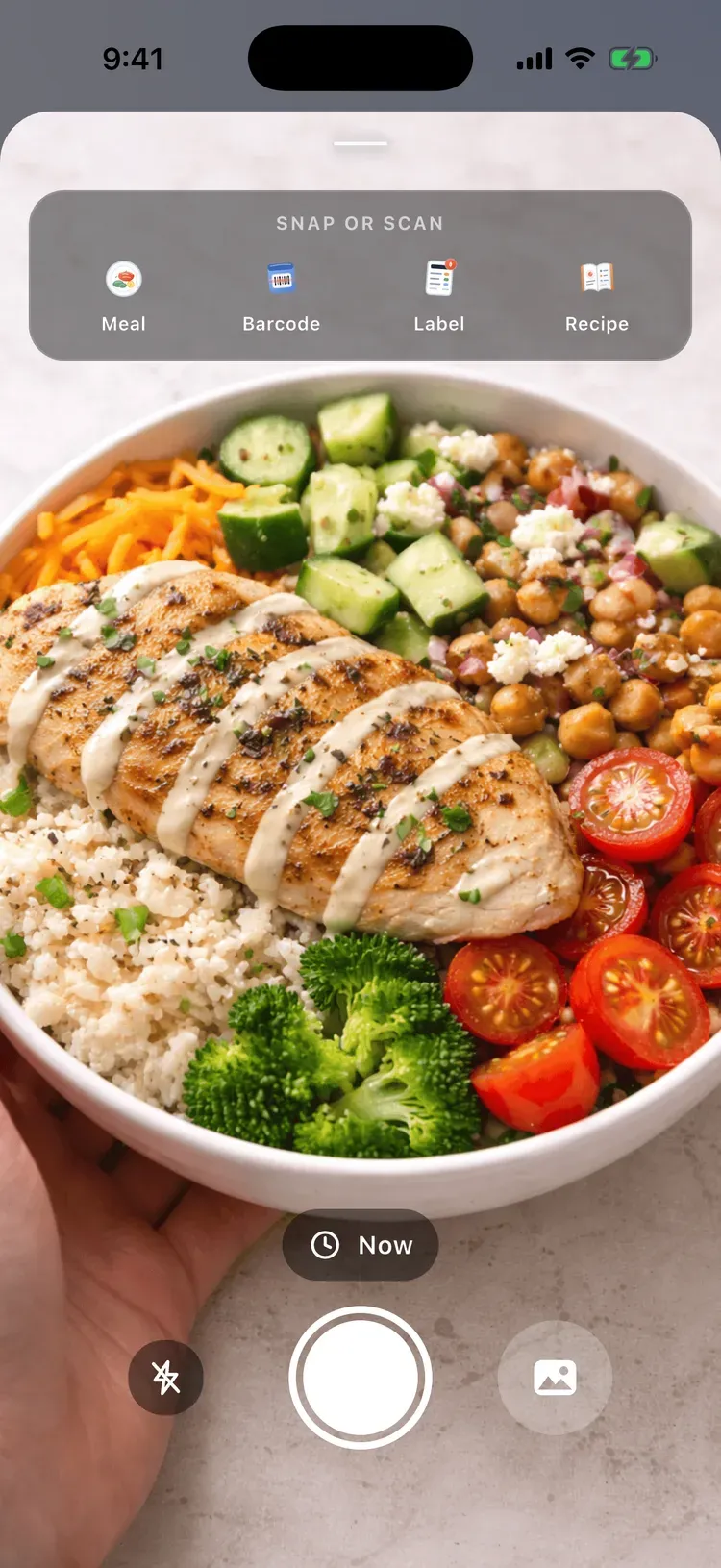
A multimodal model looks at your photo and identifies what is on the plate, then estimates portion size from visual cues — the size of the plate, the depth of the bowl, how the food is arranged. It maps each identified item to nutrition data and adds up the result.
Two of those steps are genuinely hard. Identification is the easier one: a chicken breast, a bowl of rice, and a side of broccoli are recognizable. Portion estimation is harder, because a photograph flattens depth, and the difference between 100 g and 160 g of rice can be a matter of a few pixels.
The third difficulty is invisible ingredients. A tablespoon of olive oil is around 120 kcal and leaves almost no visual trace on a finished dish. Cream in a sauce, butter on vegetables, and sugar in a marinade all behave the same way.
Where it works well, and where it struggles
It is strongest on separated, plated food: a piece of protein, a starch, and a vegetable, photographed from a slight angle in decent light. Packaged food scanned by barcode is more accurate still, because the numbers come straight from the label rather than from an estimate.
It struggles with homogeneous mixtures — stews, curries, smoothies, casseroles — where the ingredients are not individually visible. It struggles with restaurant food, which is routinely richer than it looks. And it struggles with anything shot in a way that hides scale, such as a close-up with no reference object in frame.
This is exactly why CalEasy lets you combine a photo with a voice note or a line of text in a single log. "Cooked in two tablespoons of olive oil" supplies precisely the information a photograph cannot carry, and it takes three seconds to say.
Why consistency beats precision
Suppose your estimates run 10% low across the board. You set a target, track for three weeks, and the scale barely moves. You lower the target by 200 kcal and it starts moving. The bias is now absorbed — because you calibrated against your own results rather than against an absolute truth.
Now suppose your estimates are perfectly accurate but you only log four days a week. You have no idea what your intake is, and no trend to calibrate against. The second person is far worse off than the first, despite better per-meal accuracy.
This is the honest case for photo logging: it is not the most precise method available, it is the one people keep doing. A weighed-and-recorded diary is more accurate for about ten days, which is roughly when most people abandon it.
How to get better estimates
Photograph before eating, from a slight angle rather than straight down, with something for scale in the frame — a fork or your hand will do. Include the whole plate rather than a close-up of the best-looking part.
Say or type what a photo cannot show: the cooking fat, the sauce, whether the yoghurt was full-fat. Scan the barcode when the food came out of a packet. And edit the result when you know better than the estimate — every CalEasy meal breaks into ingredients you can adjust in seconds, which is both faster than manual entry and more accurate than accepting an estimate you doubt.
For foods you eat constantly, it is worth getting the numbers right once and saving the meal. After that it is one tap, with no estimation involved at all.
How the methods compare
Barcode scanning is the most accurate for packaged food and requires no judgement. Weighing ingredients and entering them manually is the most accurate for home cooking, and by far the slowest. Photo logging is the fastest and handles food you did not cook. Voice and text sit in between: quick, and able to express things a camera cannot see.
None of these is the right answer for every meal, which is why the useful question is not "which method is most accurate" but "which method will I actually use for this meal, right now". A rough estimate that gets logged beats a precise one that does not.
Frequently asked questions
Can an app really tell calories from a photo?
It can produce a reasonable estimate. Modern multimodal models identify foods reliably on clear photos of plated meals; portion size and invisible ingredients like cooking oil are where the error concentrates. Treat the output as a good first guess that you can correct, not as a measurement.
How accurate is accurate enough for weight loss?
Consistent enough that the trend is real. If your estimates carry a steady bias, adjusting your target based on three weeks of scale data cancels it out. Random gaps in logging are far more damaging than a systematic offset.
Is barcode scanning more accurate than photos?
Yes, for packaged food — the values come from the manufacturer's label rather than from a visual estimate. Photos earn their place on food that has no barcode, which is most home cooking and everything eaten out.
Why did the AI get my meal wrong?
Most often portion size, a hidden fat, or a mixed dish where ingredients are not individually visible. Add a voice note or a line of text describing what the photo cannot show, or edit the ingredient weights directly — the correction takes seconds and makes the log right.
Do I have to photograph everything?
No. Photo, voice, text, and barcode all produce a log, and you can combine them. Use whichever is fastest for the meal in front of you; the goal is an unbroken record, not a photo album.
What the camera actually sees
Estimates, not medical advice
This article is general information, not a diagnosis, treatment, or a substitute for professional advice. Energy needs vary with body composition, medication, and health conditions. Talk to a doctor or registered dietitian before making significant dietary changes, especially if you are pregnant or breastfeeding, under 18, or managing a medical condition or eating disorder.
See the science and sources behind our numbers →Try the calculators
Calculators →Keep reading
Knowing the number is the easy part.
CalEasy turns it into a daily habit: photograph your meal, say what you ate, or type it — the AI does the counting.
Get CalEasyFree trial. Cancel anytime.