
How many calories should I eat a day?
The honest answer is that it depends on your body and how much you move — but the arithmetic is simple, and you can have a working number in about thirty seconds.
Updated 29 July 2026 5 min read
The short answer
Most adults maintain their weight somewhere between 1,800 and 2,800 kcal a day. To lose weight, eat about 15–25% below that maintenance figure; to gain, eat 10–15% above it. Your own number depends on your sex, age, height, weight, and how active you are — which is exactly what the calculator below works out.
The calculator below runs the same equations as the CalEasy app, in your browser. Nothing you enter is sent anywhere.
Your results
Results update as you change the numbers.
Daily target
1,898
kcal / day
TDEE
2,448
kcal / day
Daily deficit
550
kcal / day
Time to goal
10 weeks
Where your number comes from
Two things determine how much you burn. The first is your basal metabolic rate: what your body spends staying alive — running your brain, heart, liver, and kidneys around the clock. For most adults this is 60–70% of the daily total, which surprises people who assume exercise dominates the ledger.
The second is everything you do on top of that: walking, working, fidgeting, training, and digesting food. This calculator estimates your basal rate with the Mifflin-St Jeor equation, then applies an activity multiplier between 1.2 and 1.725 for the rest. Both parts are population averages, so treat the result as a well-informed starting point rather than a measurement of you specifically.
Typical ranges, and why yours may differ
A sedentary woman in her thirties often maintains around 1,800–2,000 kcal; an active man of similar age closer to 2,700–3,000. A taller, heavier, younger, or more muscular body burns more. A smaller, older, or less active one burns less. Weight loss itself lowers the figure, because a smaller body is cheaper to run.
Two people with identical height, weight, age, and sex can still differ by a few hundred calories a day — differences in muscle mass, thyroid function, medication, and how much they move without noticing all add up. That is not a flaw in the formula; it is why the next section matters more than the number itself.

The "2,000 calories a day" number is a label, not advice
The figure printed on food packaging exists so that percentage-of-daily-value labels have something to divide by. It was chosen as a round, representative value for labelling purposes, not as a recommendation for you. Plenty of adults should be eating meaningfully more or less than 2,000 kcal.
Treat it the way you would treat an average shoe size: useful for stocking a shop, useless for buying your own shoes.
How to turn an estimate into your real number
Pick the figure from the calculator, eat close to it for two to three weeks, and log honestly — including the oils, drinks, and bites that usually go unrecorded. Then look at what your weight actually did, comparing weekly averages rather than single mornings.
If the trend matches the plan, the estimate was good. If you are losing faster than intended, add 100–200 kcal; if nothing is moving after three consistent weeks, subtract the same. Two or three of these corrections will land you closer to your true expenditure than any equation can, because you are now measuring rather than predicting.
This is the part most people skip, and it is the part that actually works. The initial number only has to be close enough to start.

Floors worth respecting
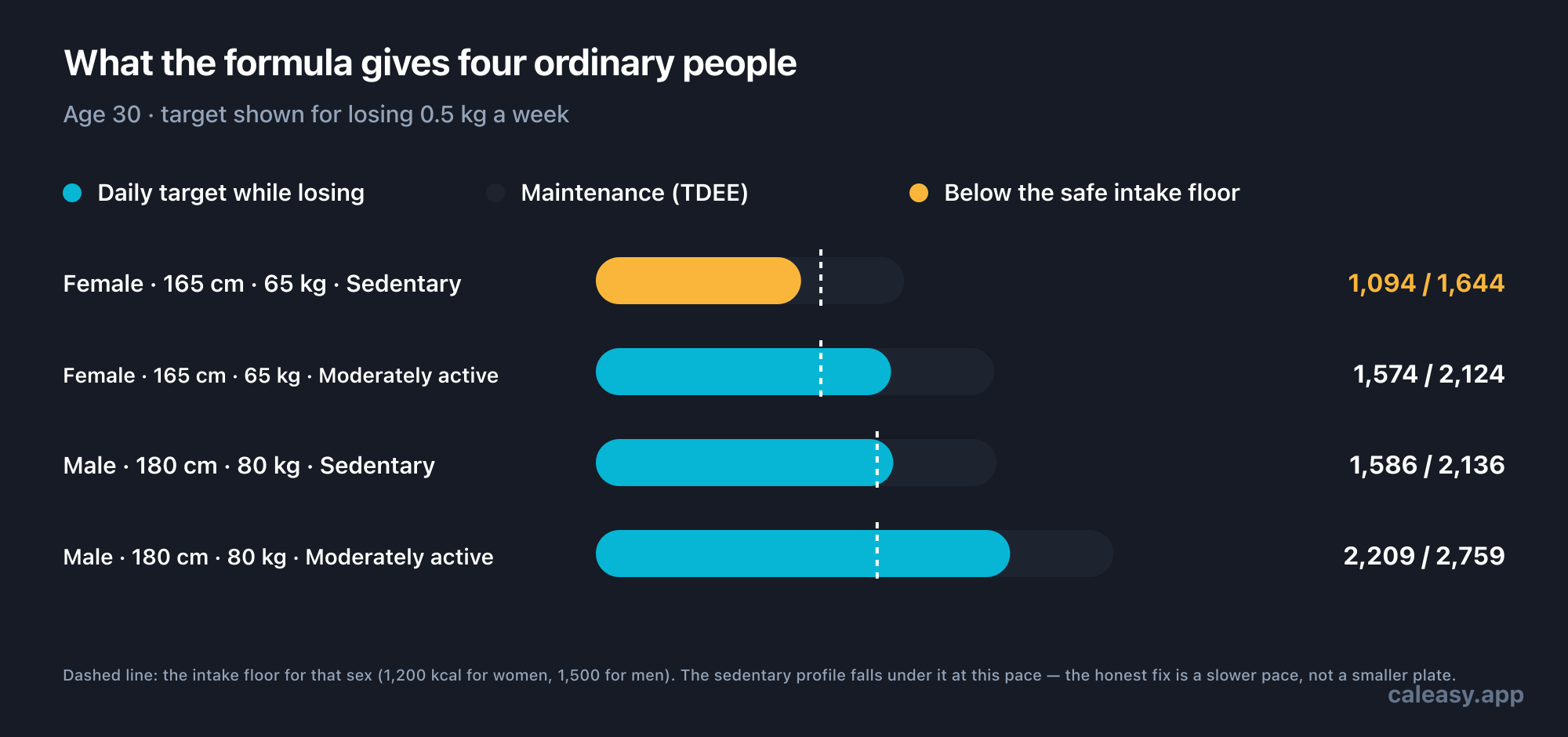
Roughly 1,200 kcal a day for women and 1,500 for men is the practical minimum most guidance uses. Below that it becomes genuinely hard to get enough protein, vitamins, and minerals from food, and more of the weight you lose tends to come from muscle rather than fat.
If your goal and your deadline only work at a number below those floors, the deadline is the thing to change. Going lower is something to do under supervision from a doctor or registered dietitian, not on your own because a calculator allowed it.
What usually goes wrong
Three mistakes account for most stalled plans. The first is overestimating activity: four gym sessions a week feel significant, but an hour of training might add 300–500 kcal to a day that already burns 2,000, and it does not turn a desk job into an active one.
The second is under-logging. Cooking oil, milk in coffee, a few chips off someone else's plate, and weekend drinking are the usual suspects, and together they can quietly erase a 500 kcal deficit.
The third is judging too fast. Water, glycogen, salt, and digestive contents move the scale by a kilogram or more overnight, which has nothing to do with fat. Give any change two to three weeks before deciding it failed.
Frequently asked questions
How many calories should I eat to lose 1 kg a week?
Roughly 1,100 kcal a day below maintenance, since about 7,700 kcal is equivalent to a kilogram of body mass. For most people that is an aggressive pace — 0.25–0.7 kg a week is easier to sustain and protects more muscle. Check where that pace would leave your daily intake before committing to it.
Is 1,500 calories a day enough?
For many smaller or less active women, 1,500 kcal is a reasonable weight-loss target. For most men it sits at or below the practical floor, and it is too low for anyone tall, heavy, or training hard. The right answer depends on your maintenance figure, not on the number in isolation.
Do I need to eat the same amount every day?
No. Your body responds to the weekly total. Eating less on quiet days and more on training or social days works perfectly well as long as the week adds up. Consistency across weeks matters far more than precision within a day.
Should I eat back exercise calories?
Not if your activity level already accounts for your training — otherwise you count it twice. Fitness trackers also tend to overestimate exercise burn, sometimes substantially. One target plus adjustment based on the scale trend is simpler and more reliable.
How often should I recalculate?
Every 4–5 kg (about 10 lb) of weight change, or whenever progress stalls for two to three consistent weeks. A smaller body burns less, so a target that worked at the start will eventually stop producing a deficit.
Estimates, not medical advice
This article is general information, not a diagnosis, treatment, or a substitute for professional advice. Energy needs vary with body composition, medication, and health conditions. Talk to a doctor or registered dietitian before making significant dietary changes, especially if you are pregnant or breastfeeding, under 18, or managing a medical condition or eating disorder.
See the science and sources behind our numbers →Try the calculators
Calculators →Keep reading
Knowing the number is the easy part.
CalEasy turns it into a daily habit: photograph your meal, say what you ate, or type it — the AI does the counting.
Get CalEasyFree trial. Cancel anytime.