
What is a calorie deficit?
It is the reason every diet that works, works — whether it counts calories, cuts carbs, or shortens your eating window.
Updated 29 July 2026 5 min read
The short answer
A calorie deficit means taking in less energy than your body spends over a period of time. Your body covers the shortfall from its own stores, and you lose weight. Everything else — which foods, which timing, which plan — is a strategy for creating that deficit and being able to live with it.
Energy in, energy out
Your body needs a certain amount of energy each day to run itself and do whatever you ask of it. Food supplies that energy. When the supply falls short of the demand, the difference comes out of storage — mostly body fat, and some muscle.
This is why the various diets that work all share one mechanism underneath. Low-carb works by making it harder to overeat carbohydrate. High-protein works partly because protein is filling. Intermittent fasting works by shrinking the window in which eating happens. None of them suspends the arithmetic; they are different routes to the same shortfall.
What a deficit is worth in weight
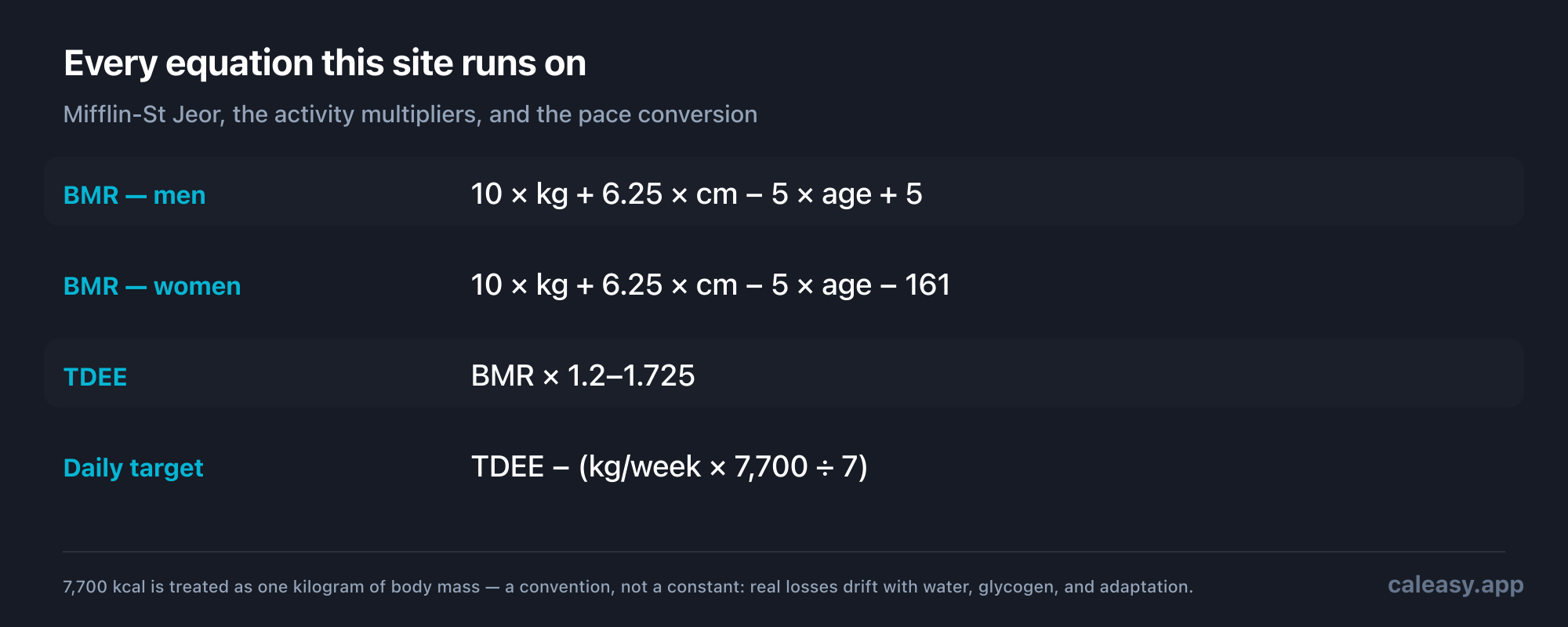
The planning convention is that roughly 7,700 kcal is equivalent to a kilogram of body mass — about 3,500 kcal per pound. A deficit of 550 kcal a day, held for a week, therefore predicts about half a kilogram lost.
That figure is a useful rule of thumb and a poor prophecy. It comes from the energy density of body fat, but real weight loss includes water and glycogen, and your expenditure drifts downward as you get smaller and as your body adapts to a sustained shortfall. Expect the arithmetic to be roughly right over months and frequently wrong over days.

Three levers, and which one to pull
You can eat less, move more, or both. Eating less is the more powerful lever for most people, simply because it is easier to not eat 500 kcal than to burn 500 kcal — the latter is roughly an hour of hard running, every day.
Movement still matters, but its main contribution is not the calories burned during exercise. Resistance training protects muscle while you are in a deficit, which changes what you lose rather than how much. And everyday movement — walking, standing, taking stairs — adds up to more over a week than most training sessions do, precisely because it is unremarkable enough to sustain.
How big should it be?
Roughly 15–25% below maintenance suits most people: often 300–700 kcal a day, or about 0.25–0.7 kg (0.5–1.5 lb) a week. A larger deficit does lose weight faster, but a greater share of it comes from muscle, and the hunger, fatigue, and irritability that come with it are what make plans collapse.
The useful test is whether you could hold the plan for a month without your sleep, training, and mood falling apart. A slower plan you finish beats a faster one you abandon in week three — and if you have a lot to lose, you can sustain a larger absolute deficit early on, then shrink it as you get leaner.
There is a floor worth respecting: around 1,200 kcal a day for women and 1,500 for men. Below it, meeting your protein and micronutrient needs from food gets genuinely difficult, and that is a supervised-by-a-professional situation rather than a do-it-yourself one.

Why the scale lies in the short term
You can be in a real deficit all week and weigh more on Sunday than you did on Monday. Body weight includes water, and water moves for reasons that have nothing to do with fat: salt intake, carbohydrate intake, hormones, hard training, and simply how much food is currently in your digestive tract.
A kilogram of day-to-day fluctuation is normal and means nothing. What means something is the direction of the weekly average over three or four weeks. Weigh under consistent conditions if you weigh at all — same time, same circumstances — and read the trend, not the reading.
Why people stall
The most common reason a deficit stops working is that it stopped being a deficit. Untracked oils, drinks, sauces, and bites accumulate quickly, and portions tend to creep upward as vigilance fades. Weight loss also lowers your expenditure, so the target that worked in month one may be maintenance by month three.
The fix is unglamorous: tighten the logging for a couple of weeks to see what is really going in, recalculate your target for your current weight, and pick a pace you can hold. A stall is information about the plan, not a verdict on you.
Frequently asked questions
How do I know if I am in a calorie deficit?
Over two to three weeks, your weekly average weight trends down. Any shorter window is dominated by water and digestive contents, and single-day readings tell you nothing useful about fat.
Can I be in a deficit and not lose weight?
Over a few weeks, no — but you can easily believe you are in one when you are not. Untracked calories and an overestimated expenditure are the usual explanations. Water retention can also mask genuine fat loss for a week or two, which is why the trend matters more than the number.
Does it matter which foods make up the deficit?
For the direction of weight change, no — the shortfall is what matters. For everything else, yes: adequate protein protects muscle, fibre and volume keep you full, and micronutrients keep you healthy. The same deficit can feel effortless or miserable depending on how you fill it.
Is a bigger deficit better?
Only up to a point. Beyond roughly 25% below maintenance, more of the loss comes from muscle, adherence drops sharply, and the risk of nutrient shortfalls rises. Faster on paper often means slower in practice.
Do I need to count calories to be in a deficit?
No — plenty of people create one by changing what they eat rather than by counting. Counting makes the deficit visible and adjustable, which is why it works well for people who have tried the intuitive route and stalled.
Estimates, not medical advice
This article is general information, not a diagnosis, treatment, or a substitute for professional advice. Energy needs vary with body composition, medication, and health conditions. Talk to a doctor or registered dietitian before making significant dietary changes, especially if you are pregnant or breastfeeding, under 18, or managing a medical condition or eating disorder.
See the science and sources behind our numbers →Try the calculators
Calculators →Keep reading
Knowing the number is the easy part.
CalEasy turns it into a daily habit: photograph your meal, say what you ate, or type it — the AI does the counting.
Get CalEasyFree trial. Cancel anytime.