
Calorie deficit calculator
Enter your details to see the calories you burn, the deficit that matches the pace you want, and roughly how long your goal will take. The calculator warns you when a pace pushes your intake below a safe intake floor instead of quietly rounding it up.
Your results
Results update as you change the numbers.
Daily target
1,898
kcal / day
TDEE
2,448
kcal / day
Daily deficit
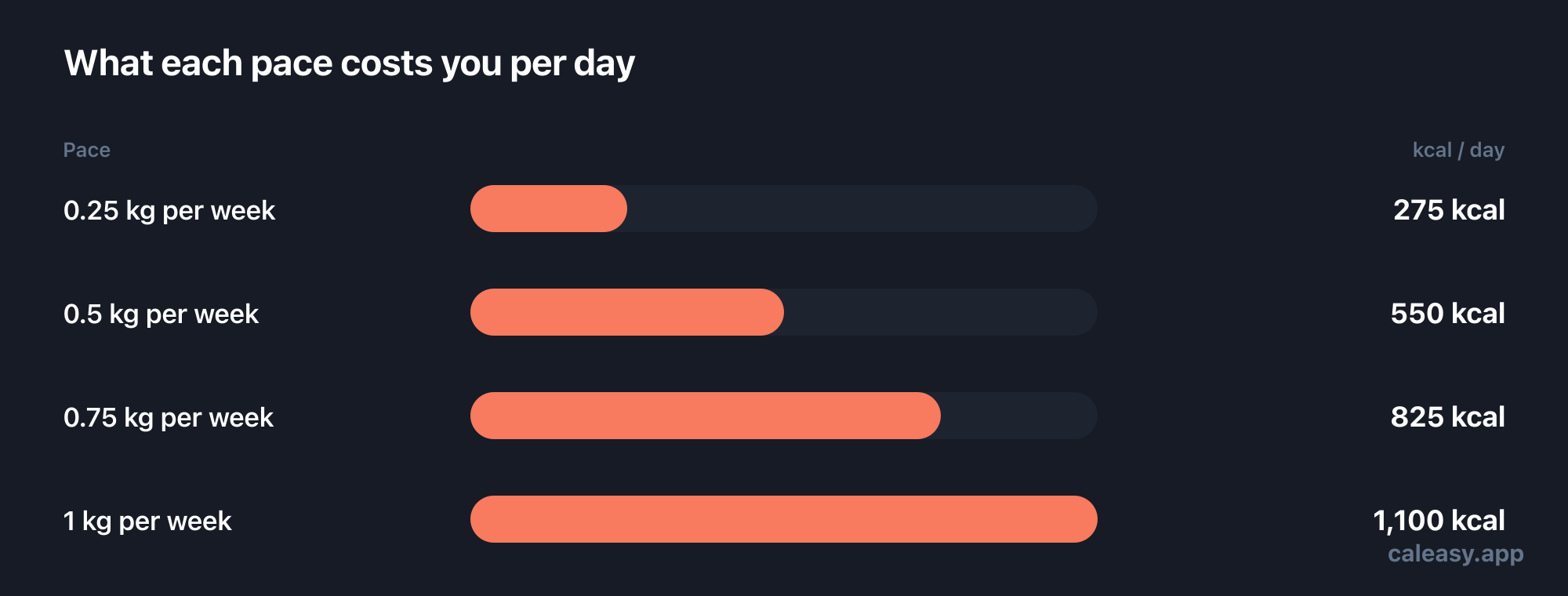
550
kcal / day
Time to goal
10 weeks
This page runs the same equations as the CalEasy app, so the plan you see here is the plan you get in the app. Nothing you enter is sent to a server — the maths runs in your browser.
What a calorie deficit actually is
A calorie deficit means eating fewer calories than your body uses over a period of time. Your body covers the shortfall from its own stores, and you lose weight. There is no way around this part: every diet that works, works because it creates a deficit, whether it counts calories, cuts carbs, or shortens your eating window.
The usual rule of thumb is that roughly 7,700 kcal is equivalent to a kilogram of body mass (about 3,500 kcal per pound). That is the conversion this calculator uses to turn a weekly pace into a daily calorie number. It is a planning estimate, not a law of physics — real-world loss is bumpier than the arithmetic suggests, because water, glycogen, and digestive contents move around from day to day.
How big should your deficit be?
A deficit of roughly 15–25% below maintenance suits most people. In practice that is often somewhere between 300 and 700 kcal a day, which works out at roughly 0.25–0.7 kg (0.5–1.5 lb) a week. Faster is not better: the larger the deficit, the more of the loss tends to come from muscle rather than fat, and the harder the plan is to stick to once hunger and fatigue build up.
A useful test is whether you could hold the plan for a month without your training, sleep, and mood falling apart. If not, the pace is too aggressive — and a slower plan you actually finish beats a fast one you abandon in week three.
If you have a lot of weight to lose, you can generally sustain a larger absolute deficit than someone close to their goal, because the deficit is a smaller share of a larger total expenditure. As you get leaner, the sensible move is to shrink the deficit, not hold it.
Why we warn instead of rounding up
When the pace you pick lands your target below about 1,200 kcal a day for women or 1,500 kcal for men, the calculator flags it rather than silently raising the number. Those floors are a widely used practical minimum: below them it becomes genuinely difficult to hit your protein, vitamin, and mineral needs from food, and the risk of losing muscle rises.
We show the honest number and the warning together so the timeline you see still matches the pace you chose. The fix is to pick a gentler pace — or, if there is a medical reason to go lower, to do it under supervision from a doctor or registered dietitian.
A worked example
Take a 30-year-old man, 180 cm and 80 kg, with a desk job and a couple of gym sessions a week. Mifflin-St Jeor puts his BMR at about 1,780 kcal. At a lightly active multiplier of 1.375, his maintenance sits near 2,450 kcal a day.
He wants to lose 5 kg at 0.5 kg a week. That pace needs a deficit of about 550 kcal a day, giving a target near 1,900 kcal — comfortably above the safe floor — and a timeline of about ten weeks. If he doubled the pace to 1 kg a week, the target would fall to about 1,350 kcal: still above the male floor, but an aggressive plan that would be hard to hold for ten weeks and more likely to cost him muscle.
What the calculator assumes
The estimate uses the Mifflin-St Jeor equation for resting metabolic rate and a standard activity multiplier for everything you do on top of that. Both are population averages: two people with identical stats can differ by a few hundred calories a day in reality.
Treat the number as a starting point, not a verdict. Track for two or three weeks, watch what your weight actually does, and adjust by 100–200 kcal if the trend is not moving the way the plan predicted. That feedback loop is what makes the number accurate for you specifically — and it is the reason logging matters more than getting the initial estimate perfect.
Frequently asked questions
How many calories should I cut to lose 1 kg a week?
Roughly 1,100 kcal a day, since about 7,700 kcal is equivalent to a kilogram. For most people that is a very aggressive deficit — 0.25–0.7 kg a week is easier to sustain and protects more muscle. Use the calculator to see where a 1 kg pace would actually leave your daily intake before committing to it.
Is a 1,200 calorie diet safe?
About 1,200 kcal for women and 1,500 kcal for men is the practical floor most guidance uses, not a target to aim for. At or below it, getting enough protein and micronutrients from food gets hard. If your plan lands there, slow the pace down — or get supervision from a doctor or dietitian.
Why am I in a deficit but not losing weight?
Usually one of three things: the deficit is smaller than you think (untracked oils, drinks, and bites add up fast), your expenditure is lower than the formula estimated, or scale weight is masked by water and digestive contents. Give any change two to three weeks of consistent logging before judging it, and compare weekly averages rather than single mornings.
Do I have to eat the same calories every day?
No. Your body responds to the weekly total, not the daily one. Eating a little less on quiet days and more on training or social days works fine as long as the week adds up. Consistency across weeks matters far more than precision within a day.
Should I eat back the calories I burn from exercise?
Not if you picked an activity level that already includes your training — otherwise you would count it twice. Fitness trackers also tend to overestimate exercise burn. If you train much harder some weeks than others, it is usually simpler to keep one target and adjust based on the trend on the scale.
Does this calculator work for weight gain?
Yes. Switch the goal to gain and it calculates a surplus instead of a deficit, at the weekly pace you choose. A slower pace — around 0.25 kg a week — keeps more of the gain as muscle rather than fat.
Estimates, not medical advice
These calculators use published equations to estimate your energy needs. They are informational only — not a diagnosis, treatment, or a substitute for professional advice. Individual needs vary with body composition, medication, and health conditions. Talk to a doctor or registered dietitian before making significant changes, especially if you are pregnant or breastfeeding, under 18, or managing a medical condition or eating disorder.
See the science and sources behind our numbers →Other calculators
Keep reading
And this is where you hit it
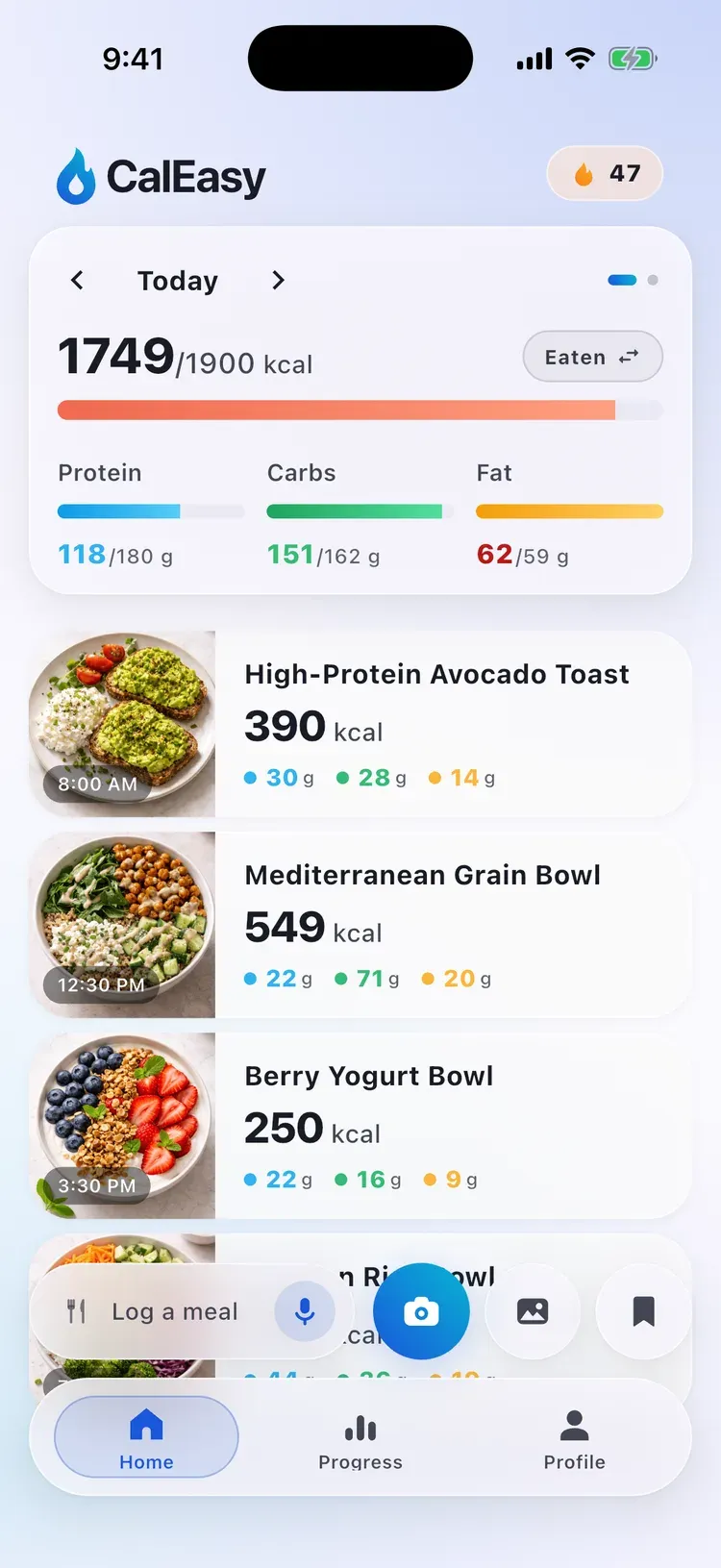
A number is easy. Hitting it every day is the hard part.
CalEasy turns your target into a daily habit: snap a photo of your meal, say what you ate, or type it — the AI does the counting. Your target, macros, and progress stay in one place.
Get CalEasyFree trial. Cancel anytime.